
Is a DTF Printer Worth It for Small Businesses? Cost, Profit, and ROI Explained
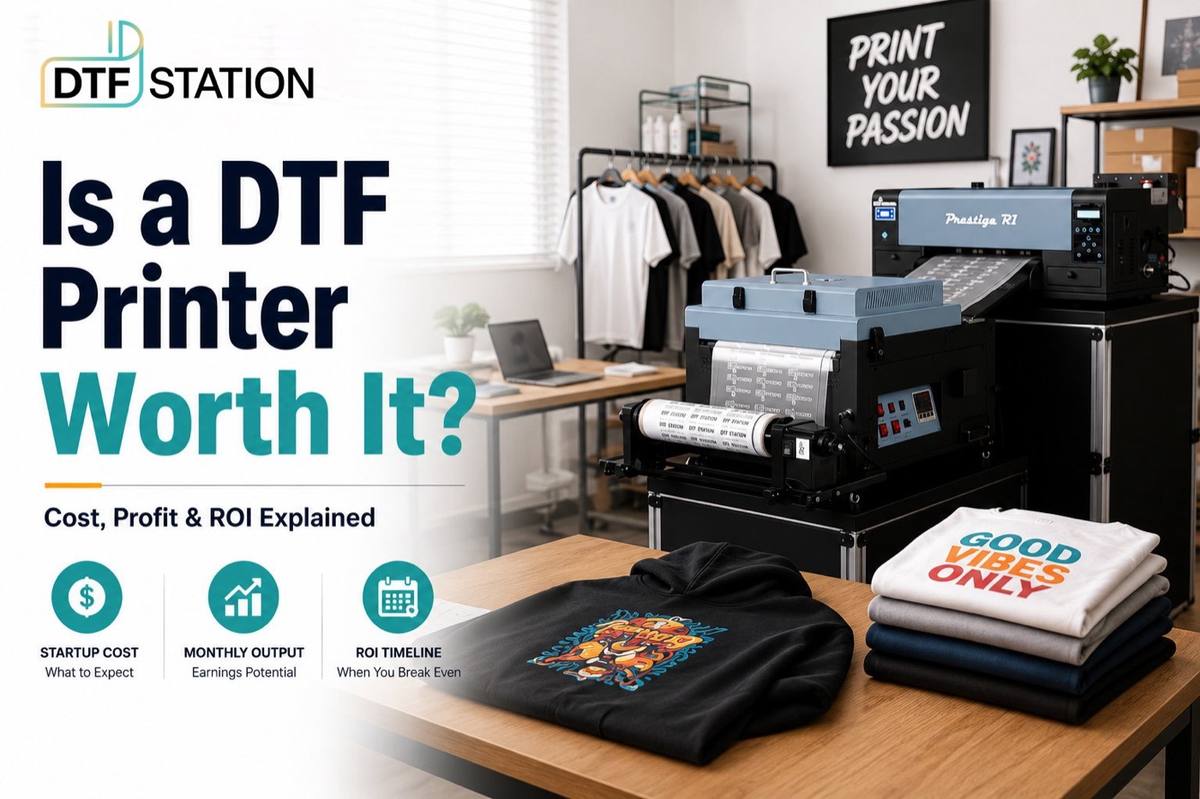
TL;DR: Yes, a DTF printer is highly profitable for small businesses printing over 30-50 garments per week. This guide breaks down the true cost of ownership, compares outsourcing versus in-house production, and reveals how to avoid the hidden maintenance traps of budget printers so you can scale your apparel margins.
Table of Contents
- Is DTF Printer Worth It for Your Small Business? (2026 ROI & Fact Check)
- Key Takeaways
- How Much Does It Cost to Print DTF In-House vs. Outsourcing?
- DTF vs. Sublimation vs. DTG: Which Technology Drives the Highest Margins?
- Hardware Nuance: Why the Printhead Dictates Your Production Speed and Reliability
- The Hidden Maintenance Tax: Avoiding the Trap of Ultra-Budget Printers
- Catalog Expansion Strategy: High-Margin Products You Can Fulfill With DTF
- Workflow and Space Optimization: Setting Up Your Shop for High Output
- 3 Non-Negotiable Signs Your Apparel Business is Ready to Upgrade
- 1. Outsourced Transfer Costs Exceed $300 Per Month
- 2. Turning Away Dark Garments and 100% Cotton Orders
- 3. Weeding Vinyl is Eating Your Labor Budget Alive
- Test Before You Scale: Choosing the Right Machine to Mitigate Inventory Risk
- Frequently Asked Questions
- At what volume does a DTF printer become profitable?
- How much daily maintenance does DTF actually require?
- Which printhead is best for a small apparel business?
- Does DTF replace sublimation and screen printing?
- Conclusion
If you’re running a custom apparel business, you’ve likely seen the hype around Direct-to-Film (DTF) printing. It promises vibrant colors, zero weeding, and the ability to print on almost any fabric. But when it comes to actually buying the equipment, the big question remains: is the investment truly justified for your specific shop size and order volume? In this guide, we’ll break down the real numbers, hidden costs, and production thresholds you need to know before making the leap.
Is DTF Printer Worth It for Your Small Business? (2026 ROI & Fact Check)
Let’s cut straight to it. Yes, a Direct-to-Film (DTF) system pays for itself—and then some—if your shop is pushing out more than 30 to 50 custom garments every week. If you’re on the fence about whether a DTF printer is worth it for your specific setup, it all comes down to the math of your order volume.
Key Takeaways
- Volume Threshold: A DTF printer becomes a money-maker once you’re running more than 30 to 50 custom garments a week.
- Cost Reduction: Moving production to your own shop floor drops your transfer costs from $4.00–$6.00 down to just $0.50 to $0.80 per A3 sheet.
- Fulfillment Speed: In-house printing enables instant, same-day turnaround, allowing you to capture high-margin rush jobs.
- Hardware Reliability: Automated white ink circulation is non-negotiable for commercial output to avoid clogs and downtime.
Relying on an outside vendor for custom transfers means you’re eating shipping costs and kissing same-day turnarounds goodbye. Having the iron on your own floor cuts out those shipping delays completely. You can print on demand the second an order drops, run test batches on new designs without sitting on a pile of unsold blanks, and actually grab those high-margin rush jobs.
Taking the leap into owning your own gear means taking a hard look at printhead specs, ink costs, and what your daily maintenance routine will actually look like. The breakdown below lays out the exact math to figure out your break-even point and protect your margins.
How Much Does It Cost to Print DTF In-House vs. Outsourcing?
Printing your DTF transfers in-house can pump up your net profit margins by as much as 80% per garment compared to buying gang sheets from a vendor.
Look at the industry averages. Ordering custom DTF transfers from a third party usually runs you between $4.00 and $6.00 per gang sheet, plus whatever they’re charging for premium shipping. When you fire up your own printer, your total consumable cost—that’s the film, the CMYK+W ink, and the adhesive powder—plummets to roughly $0.50 to $0.80 per A3 sheet.
That massive drop in overhead means you can price bulk orders aggressively and easily beat out the competition for local B2B uniform contracts. You can offer same-day fulfillment and charge a premium for the speed—something your competitors relying on outside vendors just can’t pull off.
The 100-Shirt Break-Even Scenario:
- Outsourced Cost: $400 for the transfers + $30 expedited shipping = $430 total out of pocket.
- In-House Cost: $50 total for your DTF film, ink, and adhesive powder.
- Recaptured Profit: You keep an extra $380 in your pocket on one single, small wholesale run.
To squeeze every last drop of ROI out of your machine, get strategic about the empty space on your daily gang sheets. Drop 3-inch left-chest logos, custom neck labels, or small graphics for tote bags into the blank margins around your main designs. You’re essentially printing free inventory with zero added labor cost, which can be used to pitch high-margin merchandise bundles and bump up your average order value.
DTF vs. Sublimation vs. DTG: Which Technology Drives the Highest Margins?
Direct-to-Film (DTF) delivers the highest overall profit margins simply because it kicks fabric restrictions and pretreatment bottlenecks to the curb. You can take on orders for 100% dark cotton, 50/50 blends, and notoriously tricky nylon without changing a single step in your workflow.
Sublimation traps you into selling light-colored garments with high polyester counts. That means you’re turning away lucrative jobs like corporate hoodies or standard cotton tees. Direct-to-Garment (DTG) lays down beautiful prints on cotton, but it forces you to deal with labor-intensive liquid pretreatment. That extra, messy step creates a massive bottleneck on the floor and drives up your labor costs per shirt.
| Technology | Fabric Compatibility | Setup Time per Garment | Output Flexibility | Maintenance Level |
|---|---|---|---|---|
| DTF (Direct-to-Film) | 100% Cotton, Poly, Blends, Darks, Nylon | Low (Under 15 seconds) | High (Pre-print gang sheets) | Moderate (Daily white ink circulation) |
| Sublimation | Light Polyester ONLY (65%+ Poly) | Low (Print and press) | Low (Limited blank SKUs) | Low |
| DTG (Direct-to-Garment) | High Cotton ONLY (80%+) | High (Requires liquid pretreat) | Moderate (One-off prints) | High (Printhead clogging risks) |
DTF gives you the freedom to aggressively expand your blank apparel offerings and put together cross-category merchandise bundles. You can press a heavy cotton fleece hoodie, a poly-blend polo, and a canvas tote bag all using graphics peeled off the exact same printed gang sheet. By keeping a smart mix of blank styles on the shelves and only applying pre-printed DTF transfers when a firm order comes in, you eliminate the risk of sitting on dead stock and keep your cash moving.
For a deeper breakdown of each printing method, you can also read our previous guide: Custom T-Shirt Printing: A Comprehensive Comparison of the Top 5 Methods.
Hardware Nuance: Why the Printhead Dictates Your Production Speed and Reliability
Ask any tech on the floor: your printhead is the ultimate bottleneck or accelerator for your daily production. A commercial-grade printhead dictates how fast you can push out bulk orders and totally eliminates that mid-run banding that ends up ruining expensive blank garments.
Let’s break down the three main Epson printheads you’ll see dominating the DTF market right now:
- Epson L1800 (Entry-Level): A basic photographic printhead adapted for DTF (converted desktop printer). It’s slow and meant for hobbyists. Pushing commercial volume through an L1800 is a one-way ticket to massive maintenance delays.
- Epson F1080 / XP600 (Mid-Range ): A standard multi-purpose printhead. It fires droplets faster and gives decent reliability, but tends to struggle under the heavy demands of continuous, multi-shift printing.
- Epson I1600 (Industrial): This commercial-grade piezoelectric printhead is the gold standard for shop floor output. It gives you incredible droplet control, blazing print speeds, and flawless white ink management.
To max out your daily output, you need gear that balances industrial stability with a footprint that actually fits in your shop. The Prestige R1 A3 DTF Printer hits that exact sweet spot for growing businesses. It is the first originally manufactured (instead of converted) A3+ DTF printer for users who want to try DTF printing and delivers professional-grade reliability and automated white ink circulation, making it the perfect upgrade to replace unreliable, cheap imports.
Stepping up to an industrial printhead slashes your turnaround times. You can batch-print hundreds of gang sheets on Monday, file them away, and just press the garments on demand as orders roll in all week. It’s the smartest way to guarantee you capture rush-order premiums while keeping your blanks moving out the door.
The Hidden Maintenance Tax: Avoiding the Trap of Ultra-Budget Printers
According to customer data from DTF Station Global, small shops running ultra-budget DTF printers lose an average of 15 to 20 hours a month in production time. Why? Because they’re stuck doing daily manual maintenance and fighting printhead clogs. Buying a cheap import might feel like a deal, but it brutally eats into your profit margins through wasted ink, ruined blanks, and blown fulfillment deadlines.
Here’s the science behind the headache: white DTF ink is loaded with titanium dioxide. It’s a heavy chemical compound that wants to settle and separate the second it stops moving. If it sits stagnant in an unbranded or budget system that lacks automated agitation, that heavy ink will permanently clog your dampeners and printheads.
Brands pushing ultra-budget models usually skip the proper circulation hardware entirely and offer zero offshore support when things go sideways. The Prestige R1 DTF Printer solves this nightmare by using built-in, automated white ink circulation and auto cleaning system. It guarantees your ink stays perfectly mixed and ready to fire the second you hit print.
The True Cost of Hardware Maintenance
- Ultra-Budget Imports: Heavy manual agitation daily, frequent printhead strikes, and high ink waste from constant head cleanings.
- Commercial-Grade: Automated circulation, consistent white opacity, practically zero ink waste, and real US-based technical support.
Unreliable machines force you to stockpile pre-printed gang sheets just in case the printer decides to quit on you. A dependable DTF setup lets you run a lean, just-in-time inventory model. You only print exactly what you need to fulfill the orders on today’s board, keeping your cash flow fluid while maxing out your shop’s daily output capacity.
Catalog Expansion Strategy: High-Margin Products You Can Fulfill With DTF
Direct-to-Film tech blows your product catalog wide open. It lets you print highly profitable gear like dark poly-blends, nylon jackets, and heavy canvas totes without messing around with chemical pre-treatment. Because DTF transfers bond at much lower temperatures—usually between 275°F and 320°F—you don’t have to worry about scorch marks ruining delicate synthetic fabrics.
Instead of hustling to sell single t-shirts, start grouping your products into corporate onboarding kits or seasonal sports bundles. By dropping a few different graphics onto a single A3 gang sheet, you can print the transfers for a hat, a left-chest polo, and a tote bag all at the exact same time.
You take that sheet to the press and knock out the entire kit in minutes, slashing your labor costs per item. This kind of strategic bundling instantly bumps up your average order value (AOV) by as much as 40% per B2B client.
High-Margin DTF Product Categories
| Product Category | Optimal Fabric Type | Estimated Cost to Produce | Suggested Retail Price (B2B) | Profit Margin |
|---|---|---|---|---|
| Corporate Outerwear | Nylon / Softshell | $18.00 | $45.00 | 60% |
| Activewear Sets | Spandex / Poly-blends | $12.00 | $35.00 | 65% |
| Branded Accessories | Heavy Canvas Totes | $4.00 | $15.00 | 73% |
You’re no longer handcuffed by fabric limitations or scared off by high minimum order quantities. You can confidently bid on diverse, high-ticket wholesale contracts knowing your DTF setup will handle complex materials without a hitch.
Workflow and Space Optimization: Setting Up Your Shop for High Output
Getting your DTF workflow running lean requires a dedicated, climate-controlled footprint of about 50 to 100 square feet. Setting it up right maximizes your daily garment production and kills labor bottlenecks.
You need to physically line up your production stages: the printer, the powder application station, and the heat press. Keeping the Prestige R1 DTF Printer within arm’s reach of your curing oven cuts your transit time on the floor to absolute zero. This tight setup lets a single operator manage continuous printing while simultaneously pressing finished transfers onto blanks.
Whatever you do, don’t print and press one shirt at a time. Batch your daily production. Print all your A3 gang sheets in the morning, cure them in one straight run, and spend the afternoon pressing the garments. Batch processing slashes your labor time by up to 30%, which lets you quote faster turnaround times and win those juicy B2B contracts.
Keep in mind that DTF printheads are picky about their environment. Keep your workspace temperature sitting between 68°F and 77°F, and lock your ambient humidity strictly between 40% and 60%. If you let the room get too dry, the adhesive powder will stick to the unprinted areas of the film, and you’ll end up wasting expensive blank inventory.
Optimized Production Zones
| Production Zone | Required Equipment | Minimum Space | Purpose & Commercial Impact |
|---|---|---|---|
| 1. Print Station | DTF Printer, RIP Software, PC | 15–20 sq. ft. | Continuous generation of A3 gang sheets to build daily inventory. |
| 2. Curing Station | Powder shaker or curing oven, fume extractor | 15–20 sq. ft. | Melts adhesive at 225°F–250°F to guarantee durable, retail-ready bonding. |
| 3. Finishing Station | Commercial heat press (16″x20″), blank apparel bins | 20–30 sq. ft. | Rapid application, final quality control, and order packing. |
3 Non-Negotiable Signs Your Apparel Business is Ready to Upgrade
Your apparel business is officially ready to pull the trigger on an in-house DTF printer when you hit three specific pain points: you’re spending over $300 a month on outsourced gang sheets, you’re losing sales because you can’t print on dark garments, and you’re burning billable hours weeding vinyl.
1. Outsourced Transfer Costs Exceed $300 Per Month
Buying custom DTF gang sheets online costs roughly $4 to $6 per sheet, plus shipping fees, plus a frustrating three-day wait time. Putting a machine like the Prestige R1 DTF Printer on your floor drops your production cost to literal pennies per print. Recapturing that 80% margin difference literally pays for the hardware within months.
2. Turning Away Dark Garments and 100% Cotton Orders
Sublimation traps your catalog into light-colored, high-polyester fabrics. If you’re constantly telling B2B buyers you can’t fulfill their dark hoodies or heavyweight 100% cotton tees, you are handing free money to the shop down the street. DTF tech bonds permanently to cotton, polyester, blends, and nylon without you ever having to spray a drop of pretreatment.
3. Weeding Vinyl is Eating Your Labor Budget Alive
Cutting and weeding HTV (Heat Transfer Vinyl) is a massive bottleneck on the floor that makes scaling impossible. Taking on a 50-piece corporate apparel run using vinyl means hours of tedious manual labor before a shirt even touches the heat press. DTF completely cuts weeding out of your workflow, slashing your production time by up to 70%.
Test Before You Scale: Choosing the Right Machine to Mitigate Inventory Risk
The right DTF printer kills inventory risk by letting you test new designs on demand before you dump cash into bulk garment purchases. Instead of pre-printing 500 shirts and hoping they sell, you produce the transfers the exact moment the B2B orders arrive. This just-in-time production model keeps your cash flow liquid and stops dead stock from chewing up your profits.
Relying on ultra-budget machines is a massive gamble when you’re trying to fulfill rush orders. A true commercial-grade unit gives you the rock-solid stability you need to scale fast. It delivers consistent white ink circulation and reliable droplet control without trapping you inside an overpriced, proprietary ink ecosystem.
To actually mitigate your inventory risk and move product faster, build your production around these three DTF strategies:
- Print-on-Demand Micro-Batches: Run tests on 10 to 20 new SKUs without buying a single bulk garment upfront. If a design flops, you’re only out a few pennies on the transfer film.
- Corporate Merchandising: Pitch wholesale buyers on premium bundles that include hoodies, tees, and bags all printed from one gang sheet. Only order the blank apparel from your distributor after the client pays the initial invoice.
- Rapid Restocking Cycles: Turn around high-performing items in under 24 hours. You completely bypass the standard 3-to-5-day wait times that come with outsourcing to third-party transfer vendors.
Frequently Asked Questions
At what volume does a DTF printer become profitable?
A DTF printer turns into a serious money-maker once you’re processing more than 30 to 50 custom garments per week. Once you cross that line, printing your own gang sheets drops your transfer costs from $4–$6 per outsourced sheet down to mere pennies per print. Bringing production in-house slashes your turnaround times to 24 hours, letting you win B2B contracts over competitors who are still waiting on shipping.
How much daily maintenance does DTF actually require?
Commercial-grade DTF printers require exactly 5 to 10 minutes of daily maintenance. Ultra-budget machines demand constant babysitting because the heavy white ink separates and clogs cheap printheads. Professional units come equipped with automated white ink circulation systems that stop the ink from settling and drastically cut down on manual cleaning.
Which printhead is best for a small apparel business?
The Epson I1600 printhead is hands-down the best choice for high-volume small shops that need speed and industrial stability. Entry-level L1800s are just too slow for real commercial output, and F1080 / XP600 are decent mid-range stepping stones but still fall short. The I1600 gives you the superior droplet control and rapid print speeds you absolutely need if you want to scale.
Does DTF replace sublimation and screen printing?
For the most part, yes. DTF replaces sublimation for cotton and dark garments, and it easily replaces screen printing for small-batch, multi-color orders. Sublimation physically handcuffs you to light-colored polyester. Screen printing destroys margins on orders under 24 pieces because the setup labor is so intense. DTF lets you apply vibrant, full-color designs onto cotton, blends, darks, and synthetics with zero setup time.
Conclusion
A DTF printer is a highly profitable asset—not a maintenance nightmare—but only if you invest in commercial-grade engineering and solid technical support. Buying a reliable machine on day one bridges the gap between buying expensive outsourced gang sheets and running a high-margin internal production floor.
When you control the print schedule, you have the power to pitch 24-hour rush fulfillment to local B2B accounts and demanding corporate clients. Use that speed to sell premium uniform bundles and fast-turnaround event merchandise at a significantly higher markup. Keeping total control over your margins lets you price bulk orders competitively while maximizing the cash flowing to your bottom line.
Ready to take control of your production floor and max out your profit margins? Discover how the Prestige R1 A3 DTF Printer can transform your workflow today, or get in touch with the DTF Station Global team for a personalized ROI consultation.