
DTF Ink 101: Why Your Ink Choice Is Costing You Profit
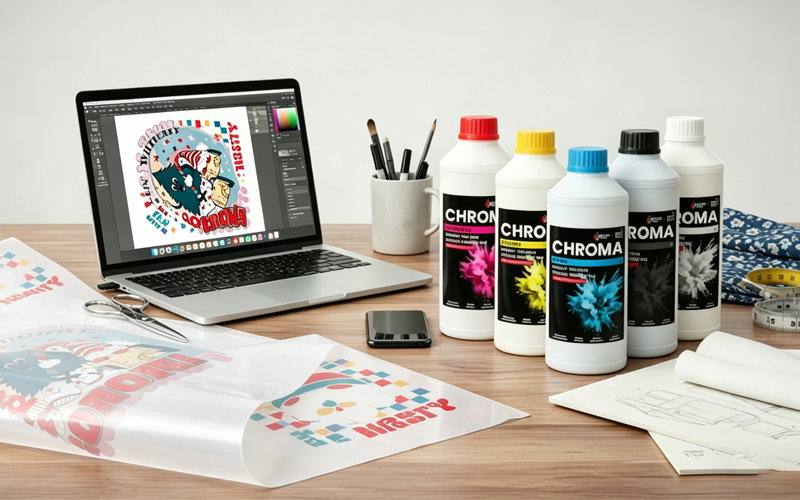
Key Takeaways: DTF ink isn’t just standard pigment; it’s a specialized chemistry designed to bond with TPU powder. To get professional results, you need high-opacity white ink and consistent CMYK viscosity. Proper storage and daily agitation are non-negotiable for success.
Table of Contents
- Why Your Ink Choice Is Killing Your Profits
- What Exactly is DTF Ink? (It’s Not Just Pigment)
- The White Ink Factor: Why It’s Your Biggest Headache
- Key Factors to Consider in DTF Ink Performance
- Color Accuracy and Gamut Size
- Nozzle Check Recovery
- Color Fuzziness
- White Ink Opacity
- Wash Fastness
- Applying This Framework: How Chroma Ink Compare in Real Tests
- What Sets Color Prime Chroma Ink Apart
- DTF Ink vs. DTG Ink: Can You Use Them Interchangeably?
- Surface Interaction
- Bonding Mechanism
- Elasticity Requirements
- 3 Signs Your DTF Ink Is Low Quality
- Maintenance Reality: Keeping the Clogs at Bay
- Frequently Asked Questions
- How long does DTF ink last?
- Can I mix different ink brands?
- Does DTF ink work on cotton and polyester?
- Can I use regular inkjet ink for DTF?
- Why is my white ink coming out grey?
- Upgrade Your Output Today
Why Your Ink Choice Is Killing Your Profits
Choosing cheap or mismatched dtf ink isn’t just a minor mistake—it’s a direct hit to your bottom line. It leads to constant print failures, trashes expensive printheads, and traps you in a cycle of endless reprints that eat your profit margins alive.
In this business, you aren’t just selling a t-shirt. You’re selling a promise—a guarantee that the design won’t crack, fade, or peel away after a few trips through the laundry.
If your ink can’t hold up its end of the bargain, your reputation goes down the drain with the rinse water.
We’ve seen the same story play out far too often: a shop tries to save fifty bucks on a liter of bulk ink, only to turn around and spend a thousand dollars replacing a clogged Epson head two weeks later.
But the damage isn’t just mechanical. Bad ink results in muddy colors and dull whites. If your customers see subpar vibrancy, they won’t be coming back. Quality dtf ink is the literal backbone of a scaling print business.
It dictates everything from the stretch of the garment to its wash fastness. It’s time to stop treating ink like a commodity and start treating it like the engine of your entire shop.
Ready to stop wasting money? Let’s break down what actually goes into a high-performance formula.
What Exactly is DTF Ink? (It’s Not Just Pigment)
DTF ink is a specialized, water-based pigment ink infused with polyurethane resin, specifically engineered to bond with adhesive powder on PET film. It’s a complex chemical cocktail of pigments, binders, and humectants designed to sit perfectly on top of the film without soaking in or “bleeding.”
The real secret sauce is the polyurethane resin. This resin acts as the bridge between the liquid ink and the hot melt powder. Without the right resin, your print could literally slide right off the film. Even worse, it might fail to bond with the glue, causing your design to peel off the shirt after a single wash.
Quality DTF ink utilizes nano-scale pigments. These particles are ground so finely (under 200nm) that they glide through the microscopic nozzles of your Epson printhead without causing blockages.
Since this ink is made for apparel, it has to be stretchy. Unlike rigid UV inks, DTF ink remains flexible, moving naturally with the fabric. Think about a chest print on a tight gym shirt: if the ink is brittle, it’ll crack the moment your customer pulls it over their head.
However, there is a catch. The white ink contains titanium dioxide. This is a heavy mineral that provides the ink’s essential opacity. Because of its weight, it naturally wants to sink to the bottom of your tanks and settle into a thick sludge.
High-performance ink stays in suspension longer. This means you’ll deal with fewer head cleanings and less wasted ink during your morning setup.
See how different inks perform across major metrics in the comparison section below.
The White Ink Factor: Why It’s Your Biggest Headache
White ink is usually the source of most printing frustrations because of those heavy titanium dioxide particles. Think of it like a bottle of Italian dressing: if it sits on the shelf, the solids settle at the bottom. In a printer, that “gunk” blocks the tiny nozzles in your printhead.
When titanium dioxide settles, your prints lose their “pop.” Since the white ink serves as your base layer, a weak white means your colors will look dull and muddy, especially on dark fabrics. You need that white layer to be thick, bright, and opaque.
It’s a bit of a trade-off: the thicker the ink, the faster it settles into a sludge in your dampers. This is why professional machines use white ink circulation systems. But even with a pump, cheap ink will still separate inside the lines. Once that sediment hardens, you’re looking at a $1,000 printhead replacement.
Pro tips for managing white ink:
- Always shake your white ink bottles before pouring them into the tanks.
- Run a small white ink purge every morning to clear out any settled pigment.
For shops looking to reduce manual handling and keep pigment consistently suspended, tools like Eddy2 ink bottle shaker can help standardize this step and improve daily reliability.
Key Factors to Consider in DTF Ink Performance
High-performance DTF ink must strike a balance between vibrant color output and mechanical reliability. To keep your printer running smoothly, the ink must have a nano-scale pigment size to ensure it’s compatible with your printheads. Beyond technical specs, look for these five markers of quality:
Color Accuracy and Gamut Size
Does the red on your screen actually match the red on the shirt? That’s color accuracy.
A wider color gamut means your ink can reproduce a broader range of shades — especially the ones that are hardest to hit, like neon oranges, deep purples, and saturated reds. When the gamut is limited, these colors tend to look dull or slightly off. High pigment density also plays a role here. It allows colors to appear richer and more solid, rather than washed out or uneven.
To better understand how color gamut is evaluated and what these differences look like in real printing, the video below walks through a side-by-side comparison:
Nozzle Check Recovery
This measures how quickly your printer gets back to work after sitting idle. If you return from lunch to find a clogged head, your ink is the culprit. Good ink stays “wet” inside the head but dries rapidly once it hits the film. You shouldn’t need five deep cleanings just to get a perfect test pattern.
Color Fuzziness
Have you ever seen colors “bleed” into one another? That’s fuzziness, and it happens when the ink doesn’t interact correctly with the film coating. Quality inks stay exactly where the nozzle drops them, keeping your text and fine details sharp. If your edges are blurry, your customers won’t be back.
White Ink Opacity
Your white ink is the wall that prevents the shirt color from showing through the design. If the base is thin, your colors will look muddy on black hoodies. You want a bright, “liquid paper” white that completely hides the fabric underneath.
Wash Fastness
This is the ultimate test of your brand’s quality. Does the print crack after three washes, or does it stay soft and vibrant for fifty? High-quality inks use premium resins that bond tightly to the adhesive powder. Don’t risk your reputation on ink that peels off in the dryer.
Want to see how pro-grade gamut actually compares? Check the breakdown below.
Applying This Framework: How Chroma Ink Compare in Real Tests
Understanding these performance factors is one thing.
But the real difference shows when you see them side by side.
Using the same testing conditions across nozzle recovery, color precision, white opacity, stability, and wash durability, the comparison below highlights how Chroma performs against other DTF inks.
| Color Prime® Chroma | Color Prime® | US Ink S | China Ink IB | US Ink N | US Ink DP | |
|---|---|---|---|---|---|---|
| Pantone Color Accuracy | 9 | 8 | 10 | 9 | 8 | 8 |
| Color Vividness | 9 | 8 | 9 | 9 | 9 | 9 |
| Greyscale Accuracy | 8 | 8 | 8 | 8 | 8 | 8 |
| Color Gamut Size (ICC DigiRIP) | 385,476 | 327,924 | 331,243 | 351,680 | 302,096 | 330,505 |
| Wash fastness (4× wash, 95°F) | 8 | 8 | 6 | 8 | 7 | 6 |
| Elongation | 8 | 8.5 | 6 | 7.5 | 8 | 7 |
| Quick Glide Film Compatibility | 9 | 9 | 8 | 6 | 8 | 5 |
| Humectant Residue | 7 | 7 | 5 | 5 | 7 | 5 |
| Overall Score | 8.3 | 8.1 | 7.4 | 7.5 | 7.9 | 6.9 |
Notes: Overall scores are the mean of 1–10 criteria shown (excluding “Color gamut size”).
For a deeper look at the full testing process and detailed results across all brands: Download the full comparison report.
What becomes clear is that performance rarely fails in one obvious way.
Instead, it shows up as small inconsistencies:
- slower recovery after cleaning,
- slight color fuzziness on edges,
- weaker white coverage,
- or faster pigment separation over time.
Individually, these may seem minor.
In production, they compound into downtime, reprints, and inconsistent output.
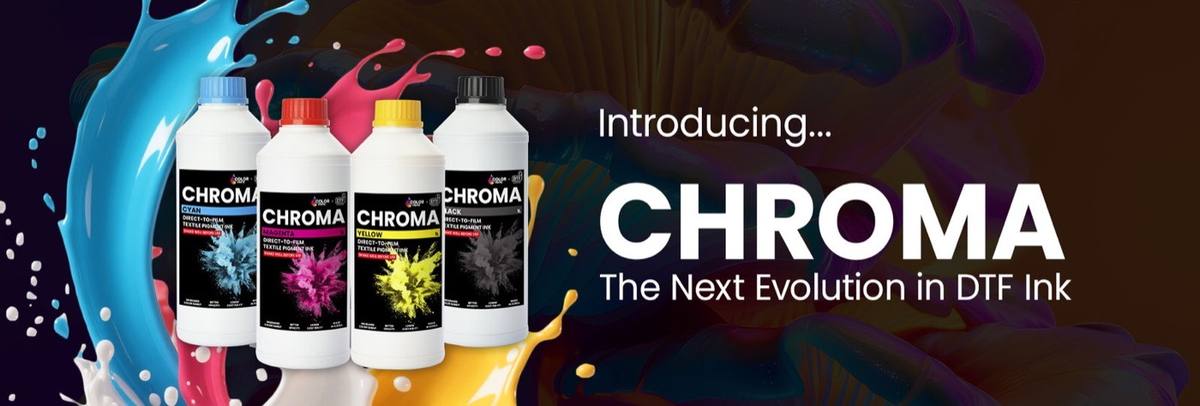
What Sets Color Prime Chroma Ink Apart
Rather than optimizing for a single metric, Chroma is formulated for balance across the entire workflow:
- wider color gamut (10–15%) for more vivid output
- stable viscosity and flow to reduce clogging and interruptions
- more consistent white ink behavior with less settling
- extended shelf stability for long-term reliability
This results in a more predictable and controlled printing process — not just better results on paper, but fewer variables in daily production.
If you’re currently dealing with inconsistent prints, it’s worth looking at your ink through this same framework. Seeing how different inks perform under the same conditions often explains more than adjusting settings ever will.
DTF Ink vs. DTG Ink: Can You Use Them Interchangeably?
The short answer is no. You cannot swap these inks because they are engineered for entirely different surfaces and chemical reactions.
Surface Interaction
DTG ink is designed to soak into natural cotton fibers like a sponge. Conversely, DTF ink is formulated to sit on top of PET film without beading or running, maintaining sharp edges until the transfer is finalized.
Bonding Mechanism
DTG ink bonds directly to the fabric fibers during curing. DTF ink, however, must bond with adhesive powder rather than the shirt itself. If you use DTG ink in a DTF setup, it will fail because it lacks the specific resins needed to “grab” the powder, leading to prints that peel off almost immediately.
Elasticity Requirements
DTF prints are essentially a thin, flexible layer of plastic. The ink requires significant elasticity to prevent cracking as the wearer moves. While DTG ink is soft, it lacks the specialized polymers found in DTF ink that allow for extreme stretching without structural failure.
Stick to the ink your system was designed for to avoid a total hardware failure.
Ready to stop guessing? [Check out our DTF-specific ink sets here.]
3 Signs Your DTF Ink Is Low Quality
You can usually spot low-quality DTF ink by three things: rapid separation in the bottle, blurry edges on your film, and prints that crack after just one wash.
The most obvious red flag is heavy sedimentation. Cheap white ink uses low-grade titanium dioxide that sinks like a stone. If you see thick sludge at the bottom of your tank after only a few hours, your ink is failing you. Quality ink stays suspended longer to protect your dampers and lines.
Then there’s the “oil spill” effect. Low-grade ink often has poor surface tension, meaning it “crawls” across the PET film instead of staying put. This creates fuzzy logos and unprofessional, muddy colors. Sharp, crisp lines are the hallmark of a high-resin formula.
Finally, the laundry test is the moment of truth. Bad ink feels stiff—like a thick, brittle sticker—and snaps when you stretch the fabric. It simply lacks the specialized polymers needed for modern, stretchy apparel. If your design peels or loses its vibrancy after a single cold wash, your ink is missing the necessary bonding agents. A pro-grade print should survive 50+ washes without fading.
Don’t let inconsistent ink compromise your results. See how our lab-tested DTF inks deliver consistent, professional output.
Maintenance Reality: Keeping the Clogs at Bay
Avoiding clogs requires a dedicated routine of ink circulation and daily cleaning. Let’s be honest: white ink is the enemy here. It’s heavy and it settles fast. If it sits still in your printhead for 24 hours, you’re looking at a costly repair.
Make it a habit to shake your ink tanks every morning to keep the pigments moving.
Moisture also matters more than most people realize. DTF ink thrives in humidity between 40% and 60%. If your room is too dry, the ink can dry inside the nozzles like superglue. Using a dedicated humidifier is a simple way to keep your print environment stable.
Don’t forget the capping station. Wipe the rubber seals with a lint-free swab and cleaning solution every evening. A dirty cap prevents an airtight seal, which leads to dried-out heads. A clean capping station is the real secret to a perfect nozzle check.
We see too many printers die from simple neglect. Spending 10 minutes on maintenance today can save you four hours of troubleshooting tomorrow. Grab our premium cleaning kit to protect your printhead.
Frequently Asked Questions
How long does DTF ink last?
Most DTF ink lasts about six to twelve months if stored in a cool, dark place. However, white ink is the exception. Because of the titanium dioxide, it separates much faster than CMYK. Gently shake your white ink bottles for 30 seconds every morning.
For shops looking to standardize this process and reduce manual effort, tools like the Eddy2 ink bottle shaker can help keep pigments evenly suspended and improve day-to-day consistency.
Can I mix different ink brands?
Avoid mixing different brands in the same tank. Every manufacturer uses a unique chemical formula, and mixing them can cause a reaction that creates “sludge” in your lines.
Does DTF ink work on cotton and polyester?
Yes—that’s the superpower of this technology! Unlike DTG, which struggles with polyester, DTF bonds to almost any fabric.
Can I use regular inkjet ink for DTF?
No, absolutely not. Standard ink lacks the binders required to grab onto TPU powder. Your print would simply slide right off the film.
Why is my white ink coming out grey?
This usually happens if your CMYK settings are too high or your white ink isn’t opaque enough to block the garment color. Check your software settings to ensure a 100% white underbase. If you can still see the shirt through the print, your ink quality is likely the issue.
Upgrade Your Output Today
Improving your output starts with treating your ink as the most critical part of your hardware. Too many shops keep buying the cheapest bottles they can find, assuming all pigment is the same. It isn’t.
Cheap DTF ink ruins printheads and burns through your profit margins. Every clogged nozzle is money lost, and every faded shirt is a customer you’ll never see again.
You deserve a setup that works as hard as you do. Switching to a premium DTF ink formula means fewer cleanings, white layers that actually stay white, and prints that feel soft but remain tough in the wash.
Stop fighting your equipment every morning. Browse the full Chroma Ink collection and start printing with confidence.