
Why Small Text Breaks Down on Some DTF Films (And How to Fix It)
Quick Answer
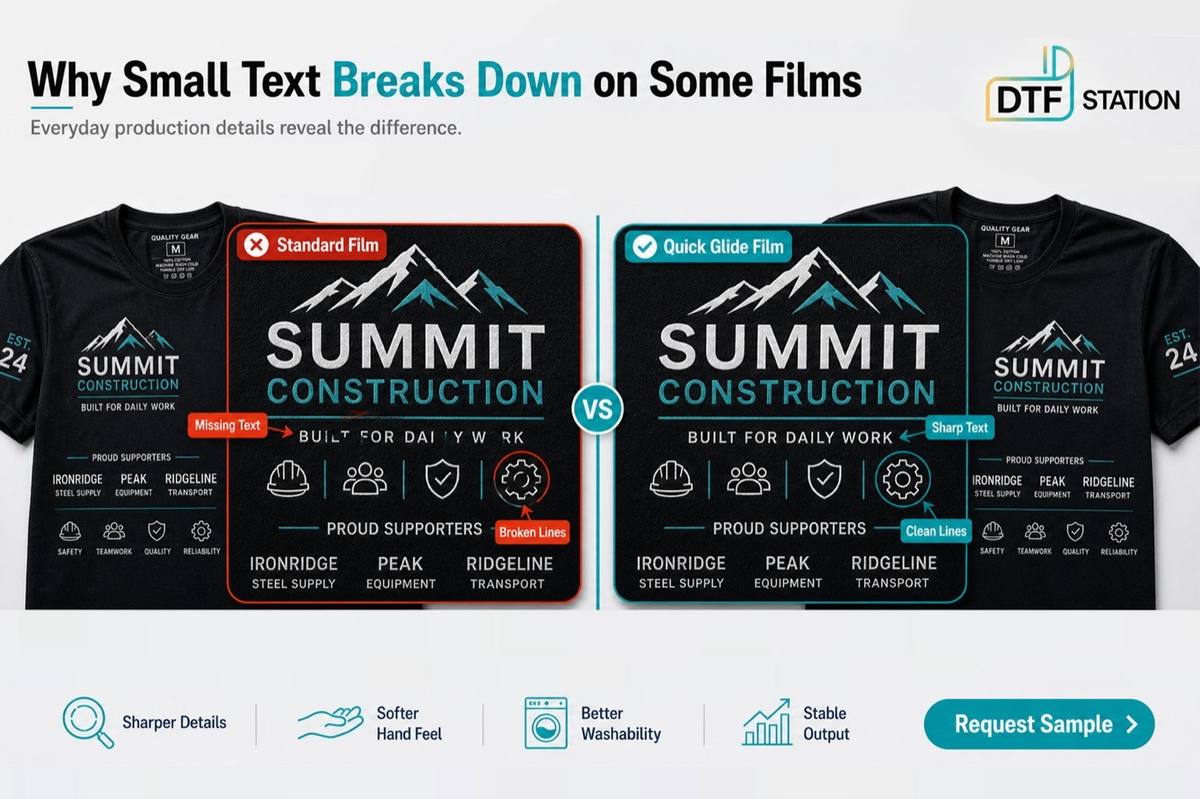
Small text and fine lines can break during DTF transfer when the ink, powder, curing setup, and film release behavior are not working together properly. Ultra-light warm peel films can be excellent for fast production and bold graphics, but very fine details may need more controlled release to stay secure during curing and peeling.
Quick Glide™ DTF Film is engineered for premium transfer quality. With an extra fine detail protection layer, in-house coating line, lab support, and automated coating process, Quick Glide™ helps preserve small text, keep fine lines cleaner, support a softer hand feel, improve wash performance, and deliver more consistent results for premium apparel production.
Table of Contents
- Quick Answer
- Why Small Text Matters in DTF Printing
- Why Fine Details Break During Transfer
- Why Finished Quality Matters More Than Peel Feel Alone
- How Quick Glide™ Supports Premium Print Quality
- Cleaner Fine Details
- Softer Hand Feel
- Better Wash Performance
- More Consistent Production
- Why Coating Control Matters
- Designed for Premium Finished Results
- Where Quick Glide™ Adds the Most Value
- How to Test Film for Small Text Performance
- Troubleshooting Small Text Issues
- Why This Matters for Business
- Choosing the Right Film Strategy
- Frequently Asked Questions
- Why do fine details break in DTF printing?
- Is Quick Glide™ only about small text?
- Does the fastest peeling DTF film guarantee the best production result?
- How do I stop neck labels from missing letters during peeling?
- How should I test a premium DTF film?
- Conclusion
Why Small Text Matters in DTF Printing
Small text is one of the toughest details to reproduce consistently in DTF printing.
A large front graphic may look acceptable even when the process is not perfectly dialed in. But small letters, thin strokes, neck labels, care instructions, sleeve details, and compact corporate logos are far less forgiving. A tiny break in one letter can make the finished garment look unfinished.
For print shops, this is not only a visual issue. Fine-detail failure can lead to wasted film, wasted ink, damaged blanks, slower production, and reprints. More importantly, it can affect how customers judge your overall quality.
This is especially important for premium apparel, private-label garments, uniforms, retail-ready products, and brand merchandise. These jobs are not only about printing a design onto fabric. They are about delivering a finished product that looks clean, feels comfortable, and holds up after use.
That is why the choice of DTF film matters.
The best film is not always the one that only peels the fastest. For many print shops, the better question is:
Does this film help me deliver the quality my customer expects?
Why Fine Details Break During Transfer
Fine-detail failure usually happens when the printed layer is not supported well enough through the full transfer process.
After printing, the design still needs to go through powdering, curing, heat pressing, peeling, and final bonding to the garment. Each step creates stress on the printed layer. Large shapes are usually easier to transfer because they have more surface area and stronger structure. Small text and thin lines are more delicate.
Common causes include:
- White ink that is too heavy or too light
- Adhesive powder that is too coarse for small details
- Uneven powder coverage
- Inconsistent curing temperature
- Uneven heat press pressure
- Artwork strokes that are too thin
- Film coating that does not support fine-detail transfer well
The film is especially important because it is the base that carries the full printed image before the design reaches the garment.
A premium DTF film needs to do more than release smoothly. It needs to hold ink cleanly, support powder adhesion, stay stable during curing, and release the design without pulling away small printed elements.
If the coating is not stable enough, fine details may lift, break, blur, or stay on the carrier film during peeling.
That is why small text is not just a printing challenge. It is also a film coating challenge.
Why Finished Quality Matters More Than Peel Feel Alone
Peel feel is only one part of DTF film performance.
For production teams, a smooth workflow matters. But for customers, the final garment matters more. They judge the result by how the print looks, how it feels, and how well it performs after washing.
That is why premium DTF film should be evaluated by the complete result:
- Are small letters complete?
- Are fine lines sharp?
- Does the transfer feel soft on the garment?
- Does the print stretch properly?
- Does it hold up after washing?
- Are results consistent across rolls and batches?
Many films on the market can provide fast peeling, and that can be valuable for production. But premium apparel requires more than a convenient peel. It requires detail retention, soft hand feel, wash durability, and consistent results.
Quick Glide™ is designed around this full-quality standard. It helps preserve fine details while supporting a softer, more flexible transfer and reliable wash performance when used with proper ink, powder, curing, and press settings.
For shops producing premium apparel, the goal is not only fast output. The goal is output that customers are proud to receive, wear, and reorder.
How Quick Glide™ Supports Premium Print Quality
Quick Glide™ is designed for print shops that want more confidence on detail-heavy and quality-sensitive jobs.
It uses an extra fine detail protection layer with a dual-release-layer design. This structure helps the printed layer stay cleaner and more complete through printing, powdering, curing, peeling, and transfer.
This matters because premium output depends on several qualities working together.
Cleaner Fine Details
Small text, thin lines, neck labels, and detailed logos need stable support before release. Quick Glide™ helps hold these delicate printed areas more securely, reducing the risk of missing letters, broken strokes, rough edges, and incomplete transfer.
Softer Hand Feel
A premium print should not only look clean. It should also feel good on the garment. Quick Glide™ is designed to support a skin-soft finished transfer, making it better suited for apparel that customers actually want to wear.
This is especially important for retail-ready products, uniforms, fashion items, and private-label garments where comfort affects customer satisfaction.
Better Wash Performance
Washability depends on the full DTF system, including ink, powder, curing, press settings, and garment fabric. But film quality still matters because it affects how cleanly and completely the printed layer transfers.
Quick Glide™ is designed to support stronger transfer integrity, helping the print bond more completely when used with proper production settings. This can contribute to better wash performance and more reliable long-term results.
More Consistent Production
For premium work, consistency is just as important as one good test print. Quick Glide™ is supported by our own coating line, in-house lab, and automated coating process. This helps control coating uniformity, release behavior, and batch stability.
For print shops, that means fewer surprises between rolls and less time spent adjusting settings from job to job.
Why Coating Control Matters
DTF film may look simple from the outside, but the coating is where much of the performance difference happens.
Small changes in coating can affect how ink sits on the film, how powder attaches, how the printed layer cures, how the film releases, and how complete the final transfer becomes.
For bold graphics, small coating variation may not always be obvious. For fine text, it can show up immediately.
That is why Quick Glide™ is built with more process control behind it.
Our own coating line allows us to manage the coating process directly. The in-house lab supports testing and adjustment. The automated coating process helps reduce variation and improve repeatability.
This structure supports:
- More stable coating thickness
- More predictable release behavior
- Better fine-detail support
- Cleaner transfer performance
- More consistent roll-to-roll quality
For a print shop, that technical control becomes practical value. It helps reduce trial and error, especially on jobs where small details and premium finishing matter. text, neck labels, fine lines, and detailed artwork.
Test Quick Glide™ DTF Film with your design—request your sample today.Designed for Premium Finished Results
A premium DTF transfer is judged after the garment is finished, not during one step of production.
Customers notice whether the logo edges look clean, whether small text is readable, whether the print feels soft on the shirt, and whether it continues to look good after washing. These are the details that make a garment feel retail-ready instead of simply decorated.
Quick Glide™ is built around that finished-garment standard.
Its slightly more controlled peel feel is intentional. It helps support transfer completeness, especially on designs with fine lines, small lettering, and detailed brand marks. Instead of focusing only on the easiest peel sensation, Quick Glide™ is designed to help protect the quality customers actually see and feel.
For print shops, this creates a more reliable foundation for premium work: custom neck labels, private-label apparel, uniforms, corporate merchandise, and retail-ready products.
The result is a transfer that can look cleaner, feel softer, wash better, and give customers more confidence in the finished garment.
Where Quick Glide™ Adds the Most Value
Quick Glide™ is especially useful for jobs where the final garment needs to look and feel more professional.
Common applications include:
- Custom neck labels
- Care instruction labels
- Small brand marks
- Left-chest corporate logos
- Sleeve details
- Fine-line illustrations
- Halftone artwork
- Premium uniforms
- Retail-ready apparel
- Private-label garment production
These jobs often carry higher customer expectations. Buyers are not only checking whether the design transferred. They are checking whether the print looks clean, feels comfortable, and reflects well on their brand.
For these applications, Quick Glide™ gives print shops a stronger foundation for premium production.
Test Quick Glide™ DTF Film for your jobs — request your sample today.How to Test Film for Small Text Performance
How to Test Film Performance for Small Text
Before using any new DTF film in full production, test it with your actual printer, ink, powder, curing setup, heat press, and garment type.
Small text performance depends on the full production system, so a real workflow test is more useful than judging peel feel alone.
A useful test file should include:
- 6-point to 8-point text
- Thin serif fonts
- Small sans-serif fonts
- Fine lines
- Sharp corners
- Small reversed-out text
- Halftone dots
- Neck label artwork
- Detailed corporate logos
After pressing, check the finished result:
- Are the letters complete?
- Are the edges clean?
- Do fine lines stay intact?
- Are halftone dots clear?
- Does any detail remain on the film?
- Does the transfer feel soft enough for the garment?
- Does the print stretch without cracking?
- Do repeated tests show similar results?
This gives a more realistic view of whether the film, ink, powder, curing, and pressing conditions are working well together.
Troubleshooting Small Text Issues
If small text breaks, lifts, or looks rough, adjust one variable at a time. This makes it easier to identify the real cause.
- If letters stay on the film: Check curing temperature and time. Undercured powder may not create enough bonding strength for small details.
- If text edges look rough: Check powder size and powder coverage. Coarse powder or uneven powdering can affect tiny gaps and thin strokes.
- If small text looks swollen or blurry: Check ink density, especially the white ink underbase. Too much ink can cause spreading, while too little may reduce bonding strength.
- If fine lines break after peeling: Check film release behavior, press pressure, curing condition, and artwork stroke thickness.
- If the print feels too heavy: Review ink load, powder amount, curing time, and artwork coverage. Hand feel is affected by the full print stack, not the film alone.
- If wash results are inconsistent: Check curing, press temperature, pressure, time, powder compatibility, garment fabric, and transfer completeness.
Small text issues usually come from a combination of factors. A stable film helps, but best results come from matching film, ink, powder, curing, pressing, and artwork settings as one system.
Why This Matters for Business
Premium DTF jobs depend on more than fast production.
Customers who order private-label apparel, uniforms, brand merchandise, and retail-ready garments care about the final result. They want clean details, comfortable feel, and reliable durability.
When your film supports those qualities, your shop can sell more than decoration. You can sell a better finished product.
Quick Glide™ helps print shops:
- Preserve fine details more reliably
- Reduce reprints on complex artwork
- Improve confidence on premium jobs
- Support softer, more wearable transfers
- Improve finished-product consistency
- Offer custom labels and detailed branding with less risk
- Build stronger trust with repeat customers
This is where film choice becomes a business decision.
A low-quality transfer can make a premium garment feel cheap. A cleaner, softer, more complete transfer helps the garment feel brand-ready.
Choosing the Right Film Strategy
Choosing the Right Film Strategy
The smartest film strategy is not simply choosing the fastest-peeling film for every job.
It is choosing the film that matches the quality requirement of the order.
For simple, bold graphics, peel speed and easy handling may be the main priority. For premium apparel, neck labels, thin lines, private-label products, and detailed logos, the final garment result matters more.
That means print shops should evaluate film by more than one factor:
- Peel experience
- Detail retention
- Hand feel
- Wash performance
- Transfer completeness
- Roll-to-roll consistency
- Production stability
For shops handling mixed production, Quick Glide™ can serve as a premium film option for jobs where quality expectations are higher.
Instead of forcing one film to handle every situation, print shops can build a more reliable workflow by matching film performance to job requirements.
That means efficient production when speed matters, and premium results when quality matters most.
Test Quick Glide™ DTF Film for your workflow—request your sample today.Frequently Asked Questions
Why do fine details break in DTF printing?
Fine details break when small printed elements are not supported well enough through curing, pressing, peeling, and final transfer.
Small text and thin lines have less surface area, so they are more sensitive to ink density, powder size, curing, pressure, artwork thickness, and film coating. Quick Glide™ helps reduce this risk with an extra fine detail protection layer and dual-release-layer design that supports cleaner, more complete transfers.
Is Quick Glide™ only about small text?
No. Small text is one important benefit, but Quick Glide™ is designed for premium overall print quality.
It supports fine detail retention, softer hand feel, better transfer completeness, improved wash performance, and more consistent production when used with the right ink, powder, curing, and press settings.
Does the fastest peeling DTF film guarantee the best production result?
No. Fast peeling can help production speed, but it does not always guarantee the best final garment quality.
For bold graphics, fast peel may work well. For premium apparel, neck labels, fine lines, and detailed logos, print shops should also consider detail retention, hand feel, washability, and consistency.
How do I stop neck labels from missing letters during peeling?
Use a detail-retention film and make sure powder, curing, ink density, artwork thickness, and press settings are properly balanced.
Quick Glide™ is designed to help hold small text more securely through transfer, reducing missing letters and broken edges when the full production setup is correct.
How should I test a premium DTF film?
Test it with your real production setup and judge the finished garment, not only the peel feel.
Use artwork with small text, thin lines, halftone dots, sharp corners, and neck labels. After pressing, check detail completeness, edge quality, hand feel, stretch, wash performance, and repeat consistency.
Conclusion
Small text breaks down in DTF printing because fine details are sensitive to every part of the production process. Ink, powder, curing, heat press settings, artwork, and film quality all affect the final result.
But the film is the foundation that carries the design through the process.
Many films can provide fast peeling. Quick Glide™ is designed for print shops that want more than speed. It is built for premium print quality, with better detail preservation, softer hand feel, stronger transfer integrity, improved wash performance, and more consistent production.
With an extra fine detail protection layer, dual-release-layer design, in-house coating line, lab support, and automated coating process, Quick Glide™ helps keep printed details cleaner and more complete from printing to final transfer.
For shops producing neck labels, detailed logos, private-label apparel, uniforms, and retail-ready garments, Quick Glide™ offers a better foundation for premium results.
Request a Free Quick Glide™ Sample and test it with your own small text, fine-line artwork, and premium apparel jobs.