
Sourcing Consistent DTF Film? Ask Suppliers These 4 Questions
Quick Answer: To ensure stable ink absorption and zero batch-to-batch variance, ask your DTF film supplier these 4 critical questions:
- Do they control their own coating process?
- Is coating thickness monitored in real-time?
- How do they ensure quality stays stable across batches?
- What is the exact film structure and layer design?
DTF Station’s Quick Glide™ film answers these demands with a 5-layer structure, real-time thickness detection, and a controlled 40 m/min coating speed designed strictly for stability.
Table of Contents
- The Hidden Cost of Inconsistent DTF Film
- Quick Answer: What Makes a Consistent DTF Film?
- The Challenge of Film Consistency at Scale
- Question 1: Do They Control Their Own Coating Process?
- Why this matters
- How regular suppliers do
- How top suppliers do
- Color Prime approach
- Question 2: Is Coating Thickness Monitored in Real Time?
- Why this matters
- How regular suppliers do
- How top suppliers do
- Color Prime approach
- Question 3: How Do They Ensure Quality Stays Stable Across Batches?
- Why this matters
- How regular suppliers do
- How top suppliers do
- Color Prime approach
- Question 4: What Is the Exact Film Structure and Layer Design?
- Why this matters
- How regular suppliers do
- How top suppliers do
- Color Prime approach
- Production Speed vs. Print Stability: Why Coating Speed Matters
- Frequently Asked Questions
- Conclusion: Protect Your Margins with Predictable Consumables
The Hidden Cost of Inconsistent DTF Film
Finding a consistent dtf film is one most critical factor in protecting your print margins. When your PET transfer film fluctuates from one roll to the next, you bleed money. Wasted white ink, ruined blank apparel, and stalled production lines add up fast. On the flip side, predictable consumables keep your automated presses humming and ensure those high-volume orders ship right on schedule.
Unfortunately, even with careful sourcing, batch-to-batch variability in DTF film can be a real challenge. One roll might perform flawlessly with perfect ink absorption and a smooth peel—but the next pallet can be a completely different story. You’re suddenly dealing with unpredictable release times and severe edge lifting. This kind of batch-to-batch variance absolutely destroys your daily throughput, forcing your operators to waste valuable hours recalibrating printer profiles.
What this means for your business: Relying on unpredictable film forces you to bake higher defect rates into your wholesale pricing, which ultimately makes you less competitive. By standardizing your supply chain around highly stable transfer films, you can confidently pitch faster turnaround times to your biggest clients.
The True Costs of Supply Chain Instability:
- Labor Waste: Your operators spend their paid hours troubleshooting transfer instability instead of actually printing.
- Material Loss: Every failed peel means throwing away expensive ink, adhesive powder, and the premium blank garment itself.
- Reputation Damage: Peeling issues or inconsistent wash fastness inevitably lead to costly client returns and damaged trust.
If you want to guarantee fast inventory turnover, you have to evaluate suppliers based on verifiable manufacturing data—not just surface-level marketing promises. Asking the right technical questions about a manufacturer’s coating process is the best way to prevent expensive production bottlenecks down the line.
Quick Answer: What Makes a Consistent DTF Film?
A truly consistent DTF film comes down to three things: automated coating ownership, real-time thickness detection, and a highly engineered multi-layer design. Judging a film just by looking at it is a mistake; you need to know exactly how it was made.
Most commercial suppliers prioritize raw volume, pushing their coating lines to maximum speeds. That aggressive pacing creates microscopic variations in the chemical layer, which directly translates to unpredictable transfer instability on your press. Premium manufacturers take a different approach, deliberately slowing the process down to use real-time coating thickness detection. This strict parameter guarantees perfectly even chemical distribution across the entire PET base.
The Manufacturing Consistency Checklist:
| Manufacturing Metric | Standard DTF Film | High-Consistency DTF Film |
|---|---|---|
| Coating Speed | 60–120 m/min (Prone to uneven coating) | 40 m/min (Ensures perfect stability) |
| Quality Control | Manual batch testing | Real-time coating thickness detection |
| Film Anatomy | Basic 2-to-3 layer design | 5-layer structure |
The Challenge of Film Consistency at Scale
A flawless test roll does not always guarantee stable performance across daily production. In DTF film manufacturing, inconsistency can appear within the same batch, but the bigger challenge often shows up from batch to batch—especially when coating control, material conditions, and quality tracking are not tightly managed.
Even small changes in coating thickness can affect how the film absorbs ink, holds white ink, releases from the garment, and performs under heat press pressure. One roll may peel cleanly, while another may require different timing or produce edge lifting. For print shops, that means more testing, more recalibration, slower output, and higher waste.
Working with a reliable film partner helps protect your margins by reducing performance surprises across production orders. Instead of judging quality from one good sample roll, look for a supplier that can prove consistency through controlled manufacturing and clear quality tracking.
That consistency protects your workflow, your press time, and your profit margin.
Question 1: Do They Control Their Own Coating Process?
Why this matters
Consistent film quality begins long before it reaches your printer. Base film quality, coating precision, and stable production conditions all impact ink absorption, release, and overall transfer performance. Variability at this stage can lead to inconsistent results, wasted time, and material loss.
How regular suppliers do
Many rely on third-party coated film or manual coating, introducing human error and variation. While the first test roll may look perfect, subsequent rolls can behave differently.
How top suppliers do
Top manufacturers control the entire coating process in-house, often using automated coating lines, environmental monitoring, and standardized procedures. This reduces variability and ensures more predictable film performance.
Color Prime approach
Color Prime uses premium base film combined with a fully automated coating line. The process is conducted in a dust-controlled environment, and every roll is produced at a controlled speed of 40 m/min (slower than typical high-speed lines of 60–120 m/min) to prioritize uniform coating over throughput. This method ensures stable ink absorption, release, and transfer performance from the first roll to the hundredth.
Test Quick Glide™ DTF Film on your own press—request your sample today.Question 2: Is Coating Thickness Monitored in Real Time?
Why this matters
Even small deviations in coating thickness can affect ink absorption, adhesion, color output, and release consistency. Unmonitored variation can slow down production and increase waste.
How regular suppliers do
Some reply on human inspection to check thickness only periodically or visually, which can allow subtle inconsistencies to appear on your press.
How top suppliers do
Top suppliers use inline real-time thickness detection systems that monitor coating continuously during production to maintain consistent film properties.
Color Prime approach
Quick Glide™ incorporates a real-time coating thickness detection system that continuously monitors each roll. Combined with automated compensation, this ensures each roll remains within tight tolerances. This level of control helps maintain predictable ink absorption and release, reducing operator adjustment time and improving daily throughput.
Test Quick Glide™ DTF Film on your own press—request your sample today.Question 3: How Do They Ensure Quality Stays Stable Across Batches?
Why this matters
A single test roll is not enough to guarantee future performance. Batch-to-batch variability can create production uncertainty and force repeated testing or recalibration.
How regular suppliers do
Some rely on manual labeling or spot checks, making it difficult to trace issues or ensure consistent future batches.
How top suppliers do
High-consistency suppliers test every batch, retain samples, and track performance over time to minimize batch-to-batch variation. Automated monitoring and environmental control are often used to maintain quality standards.
Color Prime approach
Every batch is sampled and retained for traceability, allowing print shops to verify performance and reproduce consistent results. This strict batch traceability allows engineers to cross-reference current output against historical data, guaranteeing that your hundredth roll performs exactly like your first.
Test Quick Glide™ DTF Film on your own press—request your sample today.Question 4: What Is the Exact Film Structure and Layer Design?
Why this matters
Film structure affects ink absorption, release, anti-static performance, and flatness. Poor design can lead to inconsistent transfers, edge lifting, or difficulty handling white ink.
How regular suppliers do
Many standard films use simple 2-to-3 layer designs with minimal release layers and coating thickness. These may be adequate for small-volume or low-precision printing, but can struggle in high-throughput or demanding workflows.
How top suppliers do
Top suppliers engineer multi-layer films, often with dedicated layers for release, absorption, and anti-static performance, to maintain predictable performance under varied conditions. Investing in a scientifically layered film directly increases your production capacity by eliminating bottlenecks at the heat press and drastically reducing material waste.
Color Prime approach
Quick Glide™ uses a 5-layer structure with double release layers, supporting clean instant peel and reducing edge lifting without compromise on printing results.
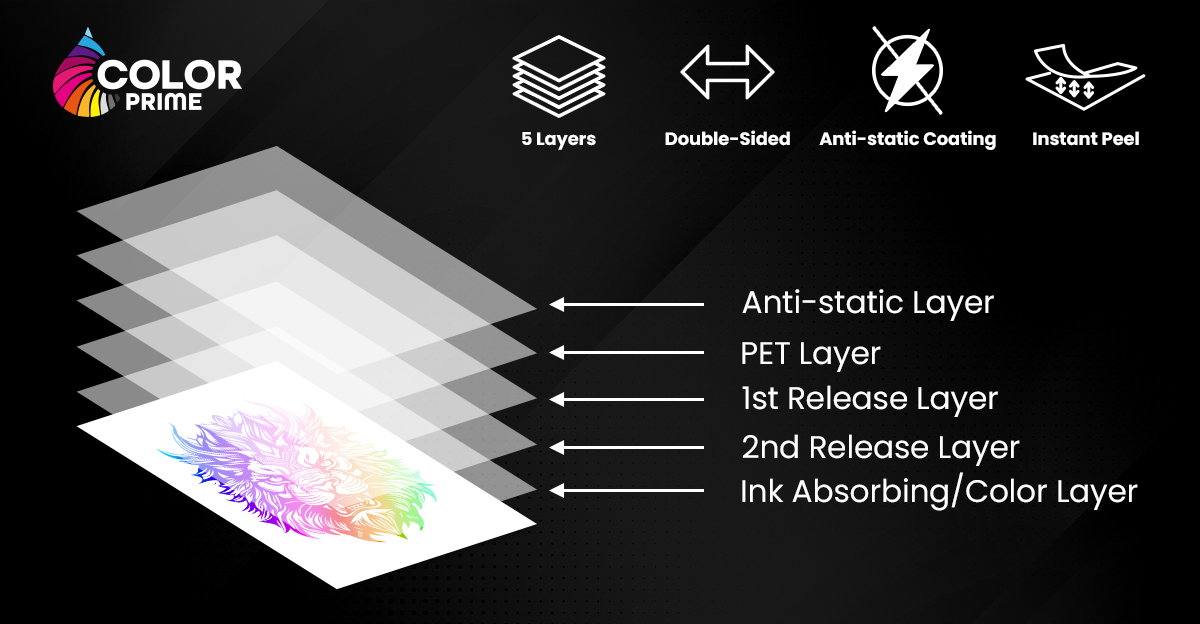 Color Prime Quick Glide Instant Peel DTF Film
 Here is how these layers dictate performance:
- Ink-Receptive Layer – Precisely absorbs ink and adhesive powder to ensure vibrant colors with perfect bonding that won’t crack or peel after washing.
- Double Release Layers: Guarantees exceptional release performance without tearing the design, drastically accelerating your workflow.
- Anti-Static Coating – Eliminates messy powder scatter so you save time on cleanup and reduce material waste.
- PET Film Base – Stays perfectly flat during printing so your designs stay crisp and aligned with no distortion.
Production Speed vs. Print Stability: Why Coating Speed Matters
In DTF film manufacturing, coating speed is not only about output volume. It also affects how evenly the coating is applied and how stable the coating becomes during drying.
Many film factories run coating lines at 60–120 m/min to improve production efficiency and reduce cost. This can be a reasonable choice for high-volume supply. However, when the goal is higher consistency, a slower coating speed can provide better process control.
Quick Glide™ is produced at 40 m/min, allowing the coating layer to spread more evenly across the base film before it enters the drying stage. The slower line speed also gives the coating more stable heat exposure during drying, helping the chemical layer form more uniformly before the film is finished.
For print shops, this matters because more stable coating can support more predictable ink absorption, cleaner release, and fewer performance surprises between rolls. Instead of chasing the lowest possible film cost, Color Prime prioritizes coating stability to help shops maintain smoother daily production.
Frequently Asked Questions
Why does my DTF film peel perfectly on one roll but ruin garments on the next?
Variation often occurs between batches. Differences in coating, base film, or production conditions can change ink absorption, release timing, or edge stability. Ask suppliers how they control and track batch performance.
How does a 5-layer film structure prevent edge lifting?
Dedicated release layers help separate the design cleanly from the carrier, reducing stress on edges. Multi-layer designs also support stable ink absorption and consistent transfer.
Does coating speed actually affect ink absorption?
Yes. Slower coating speeds guarantee perfectly even chemical distribution across the entire film surface. Most mass-market factories run at 60–120 m/min, which creates microscopic thin spots that fail to hold heavy white ink. Color Prime film slows this manufacturing process down to 40 m/min to ensure absolute consistency.
Why is an anti-static backing necessary for high-volume DTF printing?
Static attracts dust and debris, which can affect print quality and transfer stability. Anti-static layers help the film move smoothly through the printer, especially in high-volume workflows.
Conclusion: Protect Your Margins with Predictable Consumables
Predictable DTF film is one of the most controllable factors affecting print consistency and production efficiency. Using consumables with fluctuating quality can lead to wasted garments, inconsistent prints, and extra labor—directly impacting profit margins.
Achieving true consistency requires disciplined manufacturing. Slower coating speeds, such as 40 m/min, allow the chemical layer to settle evenly and dry more uniformly, while real-time thickness monitoring ensures each roll performs consistently.
A well-engineered 5-layer film structure supports clean transfers, reduces edge lifting, and helps maintain repeatable results across multiple rolls. For production shops, this translates into fewer misprints, more reliable daily output, and greater confidence when fulfilling high-volume orders.
Test Quick Glide™ DTF Film on your own press—request your sample today.