
Should You Buy a DTF Printer or Outsource DTF Transfers? A Cost, ROI & Growth Guide for Apparel Businesses (2026)
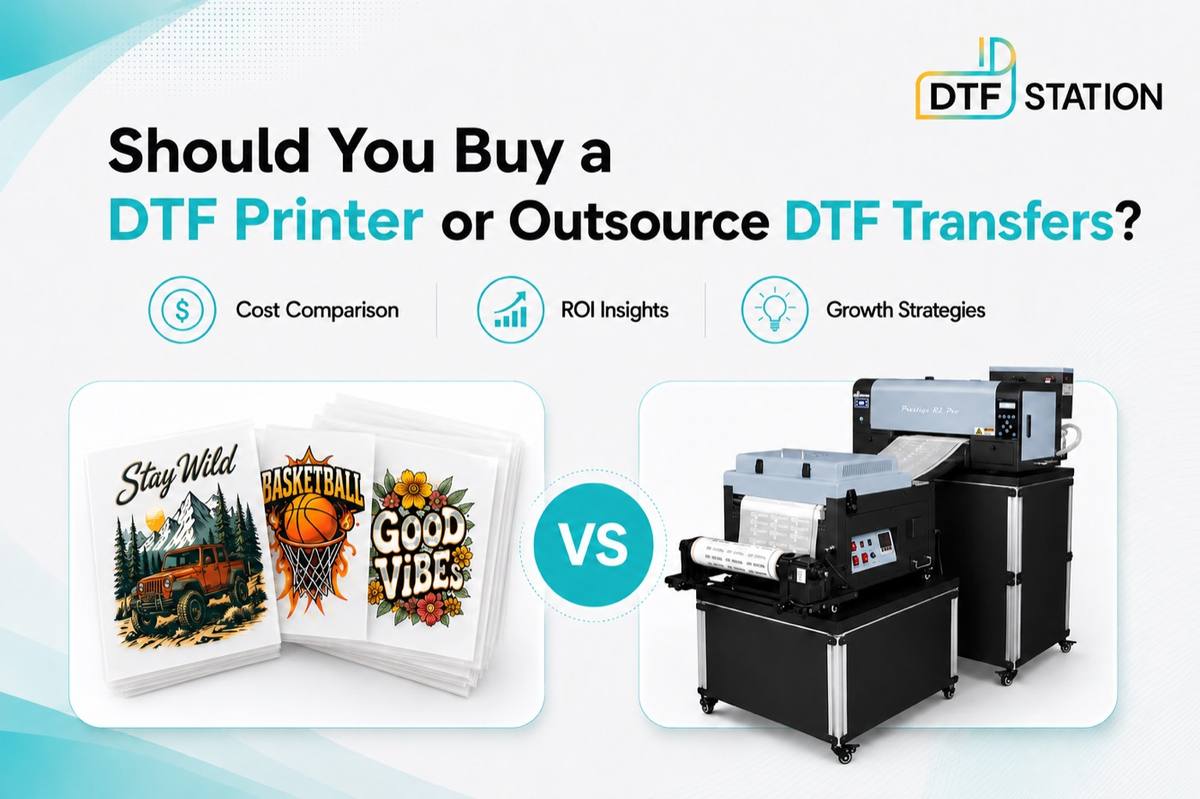
For apparel businesses, one of the most important production decisions is whether to invest in a Direct-to-Film (DTF) printing system or continue outsourcing DTF transfers.
Table of Contents
- DTF Investment Decision Matrix
- Equipment Costs
- Consumable Costs
- Maintenance Costs
- Owning a Printer Doesn’t Mean Less Work
- When Buying a DTF Printer Makes Sense
- Apparel Brand vs Print Production Company: Which Are You?
- The Hybrid Growth Model: Best of Both Worlds
- Why Many Growing Businesses Eventually Invest in Their Own DTF Production
- Ready to Explore In-House DTF Production?
- Frequently Asked Questions
- Conclusion
Many business owners assume that owning a printer automatically saves money. In reality, the right decision depends on your production volume, labor availability, technical skills, turnaround requirements, and long-term business goals.
For most startups and growing apparel brands, outsourcing DTF transfers remains the most cost-effective and low-risk option. However, once transfer volume increases and production becomes a daily operation, in-house DTF production can offer significant advantages in cost control, turnaround speed, and scalability.
This guide breaks down the real costs, ROI considerations, and operational realities behind both approaches so you can make the right decision for your business.
Quick AnswerMost apparel startups should outsource DTF transfers.
Outsourcing allows you to focus on sales, marketing, customer service, and order fulfillment without investing thousands of dollars in equipment, maintenance, and production management.
Buying a DTF printer typically makes sense when:
- You print every day
- Monthly transfer spending exceeds approximately $3,000-$5,000
- Fast turnaround is critical
- You want complete production control
- You plan to sell DTF transfers as a separate revenue stream
For many successful decorators, outsourcing first and investing later is the most profitable path.
DTF Printer vs Outsourcing: Which Option Fits Your Business?| Business Situation | Recommended Option |
|---|---|
| New apparel brand | Outsource |
| Etsy seller | Outsource |
| Less than $1,500/month in transfer purchases | Outsource |
| Seasonal production volume | Outsource |
| Daily production requirements | In-House DTF |
| Rush order fulfillment needed | In-House DTF |
| Selling transfers to other businesses | In-House DTF |
| High-volume production environment | In-House DTF |
One of the biggest misconceptions in the custom apparel industry is that owning production equipment automatically increases profitability.
In reality, most successful startups generate growth by focusing on activities that directly produce revenue:
- Acquiring customers
- Building their brand
- Marketing products
- Managing fulfillment
- Improving customer retention
Outsourcing DTF transfers allows business owners to spend more time growing the business rather than maintaining equipment.
When you outsource, you eliminate responsibilities such as:
- Daily nozzle checks
- White ink circulation monitoring
- Printhead cleaning
- Powder management
- Film inventory management
- Equipment troubleshooting
- Production downtime recovery
For many apparel entrepreneurs, the opportunity cost of managing equipment is higher than the savings gained from producing transfers internally.
How Much DTF Volume Justifies Buying a Printer?The most important factor is production volume.
A simple way to evaluate readiness is to review your annual transfer spending.
DTF Investment Decision Matrix
| Monthly Transfer Spend | Typical Recommendation |
|---|---|
| Under $500 | Outsource Transfer |
| $5,00 – $1,500 | Continue Outsourcing |
| $1,500-$3,000 | Evaluate Both Options |
| $3,000-$5,000 | Consider In-House Production |
| $10,000+/year | Strong Candidate for Owning Equipment |
Many decorators begin seriously evaluating equipment ownership after spending approximately $10,000-$15,000 annually on transfers.
However, transfer volume alone should not determine the decision. Labor costs, available space, maintenance capabilities, and production goals must also be considered.
What Are the Hidden Costs of Owning a DTF Printer?Many first-time buyers focus only on the printer price.
The actual cost of ownership is much broader.
Equipment Costs
A complete DTF production setup may include:
- DTF printer
- Powder shaker
- Curing system
- Heat press
- Air filtration system
- RIP software
- Computer workstation
Consumable Costs
Ongoing production requires:
Maintenance Costs
DTF printing is not a “set it and forget it” process.
Regular maintenance often includes:
- Daily cleaning routines
- White ink management
- Printhead maintenance
- Part replacement
- Color calibration
Ignoring maintenance can result in clogged printheads, color inconsistency, wasted materials, and expensive repairs.
How Long Does It Take to Recover the Cost of a DTF Printer?One of the most common questions apparel decorators ask is:
“When will the printer pay for itself?”
The answer depends on:
- Production volume
- Equipment cost
- Material usage
- Labor expenses
- Outsourcing costs being replaced
A business spending $4,000-$5,000 per month on outsourced transfers may recover equipment costs significantly faster than a business spending only $500 per month.
Before investing, calculate:
- Current transfer spending
- Projected production volume
- Labor costs
- Maintenance costs
- Equipment financing costs
The goal is not simply owning a printer—it is generating a positive return on investment.
Owning a DTF Printer: What You Need to KnowOwning a Printer Doesn’t Mean Less Work
Many new buyers assume that purchasing a DTF printer will automatically reduce workload and save money. The reality is that in-house DTF production adds new responsibilities:
- Artwork preparation
- Color management and calibration
- Printer monitoring during runs
- Powder application control
- Curing and heat press management
- Routine maintenance
As one experienced shop owner explains:
“You can’t start a print run and walk away expecting everything to be perfect. Technical knowledge and attention are required every step of the way.”
Without proper management, downtime and material waste can negate any savings from producing in-house.
When Buying a DTF Printer Makes Sense
Investing in a printer is justified when:
- Faster Turnaround Is Critical
In-house production allows same-day fulfillment and flexibility for rush orders. - You Print Daily
Daily usage maximizes ROI and reduces per-transfer cost. - You Plan to Sell Transfers
Beyond printing for your brand, offering transfers to other decorators creates a new revenue stream. - Technical Resources Are Available
You or your team should be comfortable troubleshooting, performing maintenance, and learning production workflows.
Apparel Brand vs Print Production Company: Which Are You?
Before investing, define your business model:
| Business Type | Focus | DTF Equipment Recommendation |
|---|---|---|
| Custom Apparel Brand | Sales, marketing, customer growth | Outsource transfers to minimize overhead |
| Print Production Company | Manufacturing, production efficiency | Invest in DTF equipment for scalability and profitability |
The Hybrid Growth Model: Best of Both Worlds
Many successful apparel businesses adopt a hybrid approach:
- Stage 1: Start by outsourcing transfers to reduce upfront costs.
- Stage 2: Grow customer demand and learn production workflows.
- Stage 3: Invest in in-house DTF printers for high-volume or specialized jobs.
- Stage 4: Continue outsourcing overflow or large projects to reduce risk.
This approach balances flexibility, growth, and operational efficiency.
Why Many Growing Businesses Eventually Invest in Their Own DTF Production
As transfer volume increases, many apparel businesses begin looking for greater production control, faster turnaround times, and lower per-print costs.
Building an in-house DTF operation can provide:
- Greater control over production schedules
- Faster response to rush orders
- Improved profit margins at higher volumes
- Opportunities to expand into wholesale transfer sales
- More flexibility when scaling production
The key is choosing equipment and workflows that match your current business stage and future growth plans.
At DTF STATION, we help businesses build reliable DTF production operations—from first-time users launching their apparel brand to established print shops expanding into high-volume manufacturing.
Our solutions include:
- DTF printers for startup, commercial, and industrial production
- Automated powder shaker and curing systems
- DTF films, inks, powders, and cleaning solutions
- Heat presses and production accessories
- RIP software and workflow solutions
- Technical training and onboarding
- Ongoing support for production optimization and business growth
Whether you’re evaluating your first DTF printer or planning a large-scale production upgrade, the goal is the same: selecting a solution that supports your production requirements, profitability targets, and long-term growth strategy.
Ready to Explore In-House DTF Production?
- Speak with a DTF specialist about the right setup for your business
- Browse DTF printer solutions for every production level
- Compare beginner, commercial, and industrial DTF systems
- Learn about complete DTF workflows, consumables, and maintenance requirements
Frequently Asked Questions
- Is owning a DTF printer cheaper than outsourcing?
Owning can become cheaper only at sufficient monthly volume; otherwise, outsourcing remains cost-effective. - Can a DTF printer run itself?
No. Regular monitoring, maintenance, and operator expertise are required. - How much DTF volume do I need before buying a printer?
Typically, when monthly spending exceeds $3,000-$5,000 or annual spending approaches $10,000-$15,000. - Should beginners buy a DTF printer?
Most beginners benefit from outsourcing until demand is predictable. - What are the hidden costs of DTF printers?
Equipment, consumables, maintenance, labor, and downtime risks. - Is DTF printing profitable for small businesses?
Profitability depends on volume, operational efficiency, and outsourcing costs versus equipment ROI. - How long does it take to recover a DTF printer investment?
Depending on transfer volume and labor costs, ROI can range from 6–18 months. - What maintenance does a DTF printer require?
Daily cleaning, white ink circulation, part replacement, powder and film management, and color calibration. - Can I run a DTF printer part-time?
You can, but ROI improves with consistent, daily usage. - What happens if a DTF printhead clogs?
Downtime and material waste occur; preventive maintenance is crucial. - Can I start a clothing brand without a DTF printer?
Yes, outsourcing allows you to grow sales first without heavy equipment investment. - What is the best DTF printer for a growing apparel business?
It depends on production volume, space, technical skills, and budget; consult DTF STATION for guidance.
Conclusion
Deciding between outsourcing and owning a DTF printer is not about preference—it’s about data and business strategy.
- Startups and small brands: Outsource to maximize time and minimize risk.
- Growing brands with high volume: Consider in-house production for cost control, faster turnaround, and additional revenue opportunities.
- Hybrid models: Offer flexibility and mitigate production risk while scaling operations.
Ultimately, the most successful decorators purchase printers because the numbers and business model make sense—not because they simply want equipment.