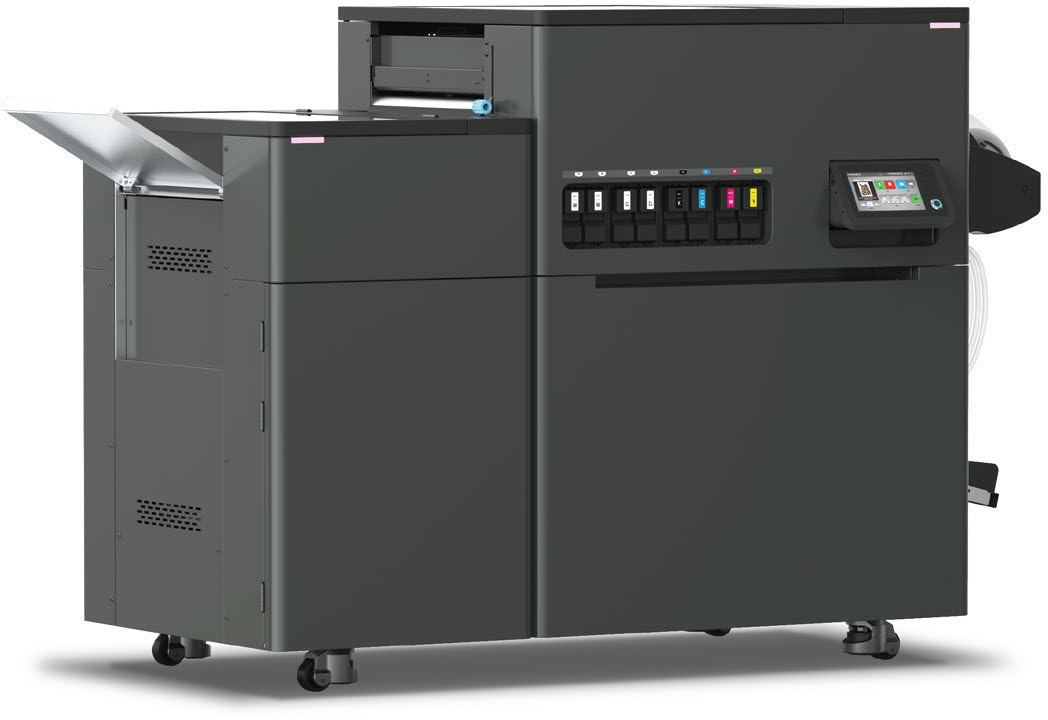
Engineered and built in Korea. Backed by DTF Station support in the US.
Drag to turn · tap a dot to open it
Print engine
Two carriages, eight ink channels.
Industrial printheads with a stainless-steel face, rated for five years. Two sets of media guides and a pair of film rollers hold the film flat the length of the bed, so head strikes are virtually impossible.
Color Prime Chroma water-based pigment in sealed cartridges. White ink circulates every hour, the heads clean on a schedule, and after six hours idle they seal themselves into a wet cap — so a quiet week does not cost you a printhead.
A single tilt touchscreen runs both sections. It tracks what maintenance is due and when it was last done, reports error codes back to support, and takes software updates on its own.
Open the doors and the whole finishing section is at hand: the powder cartridge on the left, the filter drawer on the right. Powdering, curing and filtration all happen inside the enclosure, at 67 dB(A) or less.
Adhesive powder is metered from a sealed cartridge by a rotating paddle, and the excess is captured inside the machine. Nothing airborne, no tray to shovel. One cartridge runs about one full 328 ft roll of film.
A de-mist stage, a medium stage, then HEPA and activated carbon. Fumes and fine adhesive powder are captured inside the machine, so no external ventilation is required.
An enclosed conveyor bed with four independently controlled heater zones, held at 320 °F by a PID controller. The operator never sets a cure temperature, so there is no setting to get wrong.
An inline shuttle cutter trims each sheet in 0.8 seconds, at any length between 10 and 19.7 in. Finished sheets drop cut and squared into the integrated stacker, up to one hundred of them. Lift the stacker out and the run length becomes the roll instead.
A 17 in roll on a motorized, auto-tensioning unwinder with edge-driven pinch rollers. One 2.4 lb powder cartridge runs about one 328 ft roll, so neither runs out before the other.
The print section mounts on top of the finishing section. Film feeds up and back down, so the wet ink side stays up while powdering and curing sit underneath the printer rather than beside it. Film goes in and comes out on the same side.
Point your phone’s camera at this code. The page opens on your phone; tap “See it in your space” and a full-size Vega S17 appears in the room, at true scale.
1
operator
100
sheets stacked, unattended
0
times you touch powder
67
dB(A) or less
Why it is different
Three things that are true here and hard to find together
Every machine in this category is sold on the promise that you can send a job and walk away. Here is the mechanism behind each claim, so you can check it rather than take it.
Walking away is a mechanism, not a promise.
Film travels a short, fully supported path and is cut into sheets rather than pulled on as one long web. There is no unsupported span for tension to act on, so there is nothing to skew — and nothing to stand and watch.
Built like office equipment, because it is.
Fully enclosed, 67 dB(A) or less, with three-stage filtration that captures fumes and fine adhesive powder inside the machine. No external ventilation to install, so the building stops being the obstacle to bringing transfers in house.
One person runs the line — and is not standing at it.
Powder is sealed in a cartridge and applied automatically. The cure is preset. Cutting happens inline and finished sheets stack themselves, up to one hundred. Send the file and go run the press.
Features
What is inside the Vega S17
Sealed powder cartridge
Your hands never touch powder.
Adhesive powder is metered from a sealed cartridge by a rotating paddle, and the excess is captured inside the machine. Nothing airborne, no tray to shovel. One cartridge runs about one full 328 ft roll of film.
Four cure zones
The cure is already dialed in.
An enclosed conveyor bed with four independently controlled heater zones, held at 320 °F by a PID controller. The operator never sets a cure temperature, so there is no setting to get wrong and no result that depends on who is on shift.
Inline cutter and stacker
Sheets that fit the press you already own.
An inline shuttle cutter trims each sheet in 0.8 seconds, at any length you choose between 10 and 19.7 in. Finished sheets drop cut and squared into the integrated stacker, up to one hundred of them. Lift the stacker out and the run length becomes the roll instead.
Three-stage filtration
Nothing to duct.
A de-mist stage, a medium stage, then HEPA and activated carbon. Fumes and fine adhesive powder are captured inside the machine, so no external ventilation is required.
One touchscreen
It tells you what it needs.
A single tilt touchscreen runs both sections. It tracks what maintenance is due and when it was last done, reports error codes back to support, and takes software updates on its own — so nothing depends on somebody remembering.
A film path folded to save floor
One footprint, not a row of machines.
The print section mounts on top of the finishing section. Film feeds up and back down, so the wet ink side stays up while powdering and curing sit underneath the printer rather than beside it. Film goes in and comes out on the same side, so a second unit stands right next to the first.
What you will actually touch
Powder cartridge bay
Rotating paddle metering
Cut sheets, squared
HEPA and carbon filter trays
Maintenance tracked on the panel
Print section on the finishing section
Tech specs
Vega S17
Print engine
TechnologyPiezoelectric drop-on-demand inkjet
PrintheadsRicoh industrial, stainless-steel face, rated 5 years
Automatic maintenanceHourly white-ink circulation, scheduled head cleaning, wet capping after 6 h idle
Noise67 dB(A) or less
Physical and power
Footprint67.1 × 31.4 in (170.4 × 79.8 cm) · the print section mounts on the finishing section
Print section50.9 × 31.4 × 21.2 in · 243 lb
Finishing section67.1 × 31.4 × 41.9 in · 384 lb · on casters
Combined weight626 lb (284 kg)
Doorway31.4 in deep — passes a standard doorway
Power120 V, 50/60 Hz · one cord per section: print 4 A (400 W), finishing 11.2 A (1,250 W) · each needs its own circuit · confirm requirements with us before installation
It depends on what you sell. If your product is gang-sheet rolls sold by the yard, width is yield and you want a wider roll-to-roll machine — ask us about the Prestige XL2 or XL4 with a Seismo shaker. If you press what you print, you gang jobs onto every sheet and stop paying for width and floor you never use. A 15.5 × 19 in image fits a 16 × 20 in platen.
How fast is it?
We have not published a speed figure, because we have not finished measuring one on production units. We would rather leave it blank than borrow a number. What we can tell you is that the two sections synchronize automatically, so finishing never caps output below what the printer produces. Ask us where the measurement stands.
Does it need ventilation?
No external ventilation is required. Curing is enclosed, and three-stage filtration ending in HEPA and activated carbon captures fumes and fine adhesive powder inside the machine.
What power does it need?
It runs on standard US 120 V, 50/60 Hz. Each section has its own power cord: the print section draws up to 4 A (400 W) and the finishing section 11.2 A (1,250 W). Together that is about 15 A, more than one standard 15 A circuit should carry, so the two sections cannot share one. Confirm the circuit requirements with us before installation. It is the question worth asking early, while an electrician can still be scheduled around it.
What happens if it sits unused?
It is designed to stay powered so it can look after itself. White ink circulates hourly, channels clean on a schedule, and after six hours idle the heads seal into a cap station filled with cleaning solution. If it will be powered off for two weeks or more, flush the ink and charge the system with storage fluid first.
How does this compare to buying a printer and a shaker separately?
Separately, you are buying components and assembling the line yourself: the shaker, the oven, the cutter, the extraction, the floor for all of it, and the person standing over it. Both routes are legitimate and we sell both. The question worth answering is how many labor minutes each one costs you per finished transfer.